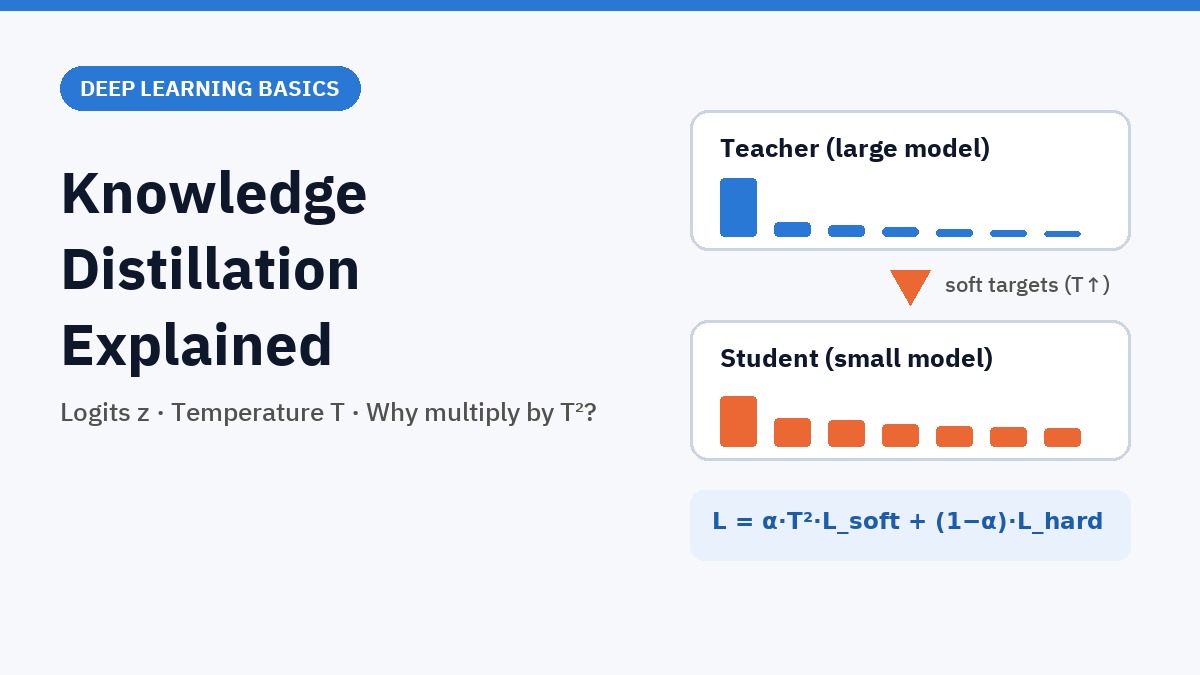
Knowledge distillation is a way to transfer what a large model (the teacher) has learned into a smaller model (the student). The method proposed in the 2015 paper "Distilling the Knowledge in a Neural Network" by Hinton, Vinyals, and Dean is still the most basic form of it.
This post walks through the three core ideas of that paper for a classifier whose output layer is a softmax, using equations, tables, and charts.
📌 Questions this post answers
Q1. What exactly is z in the equations? → the logit, the value right before the softmax
Q2. What does the temperature T do? → it makes the probability distribution softer
Q3. Why is the loss multiplied by T²? → because raising T shrinks the gradient by 1/T²
1. Notation first
Before reading the equations, let's agree on what each symbol means.
| Symbol | Meaning | Note |
|---|---|---|
| zi | The student's logit for class i | Output of the last linear layer, before any activation |
| vi | The teacher's logit | The paper writes the teacher's logits as v |
| T | Temperature | T = 1 gives the ordinary softmax |
| qi | The student's softmax probability | Softmax of z divided by T |
| pi | The teacher's softmax probability = soft target | Softmax of v divided by the same T |
| y | The true label (one-hot) = hard target | 1 for the correct class, 0 elsewhere |
| N | Number of classes | 10 for digit classification |
2. z is the logit, the raw score before the softmax
The last linear layer of a classifier outputs one real number per class. That number is the logit z. It has no fixed range: it can be 8.0 or −1.0. The softmax turns logits into probabilities, and distillation adds one more ingredient: the temperature T.
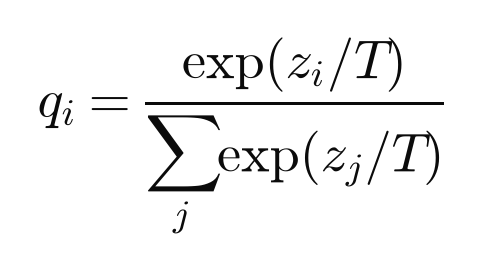
Dividing the logits by T changes the result a lot. Suppose the teacher produces these logits for an image of a handwritten "2":
| Class | 2 | 3 | 7 | 1 | 8 | 0 | 4 | 5 | 6 | 9 |
|---|---|---|---|---|---|---|---|---|---|---|
| Logit v | 8.0 | 2.0 | 1.5 | 0.5 | 0.0 | 0.0 | −0.5 | −0.5 | −1.0 | −1.0 |
Here is the softmax of those same logits at different temperatures (computed directly):
| Temperature T | P("2") | P("3") | P("7") | Other 7 classes | Entropy |
|---|---|---|---|---|---|
| 1 (ordinary softmax) | 99.4% | 0.2% | 0.1% | 0.3% | 0.05 |
| 2 | 83.4% | 4.2% | 3.2% | 9.2% | 0.79 |
| 5 | 34.5% | 10.4% | 9.4% | 45.7% | 2.07 |
| 10 | 19.6% | 10.7% | 10.2% | 59.5% | 2.26 |
| 20 | 14.1% | 10.5% | 10.2% | 65.2% | 2.29 |
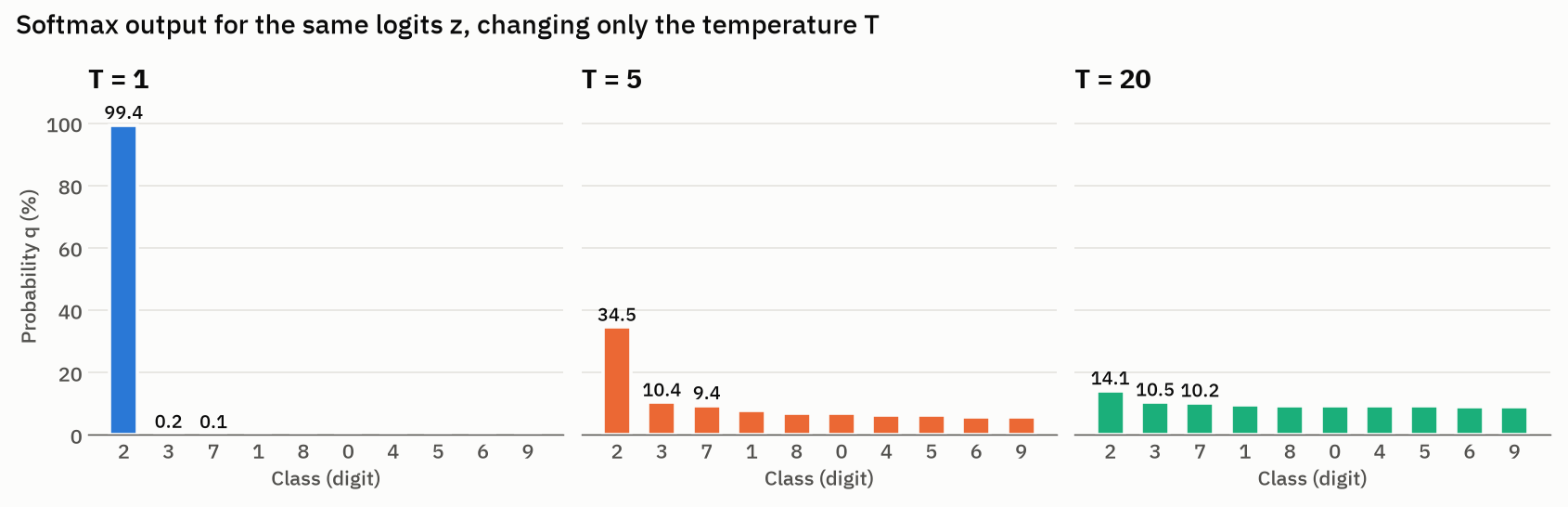
- T = 1: the exponential blows up the differences between logits, so almost all probability goes to "2". The fact that "3" gets 0.2% and "7" gets 0.1% is effectively zero and provides almost no learning signal.
- Larger T: dividing by T shrinks the gaps between logits, so the distribution softens. The maximum entropy is ln 10 ≈ 2.30, so at T = 20 it is already close to uniform.
- T → ∞: every class converges to 1/N (10%).
3. Why a soft distribution is useful: soft targets
The true label y only says "this is a 2". The teacher's soft distribution says more: "it's a 2, but if anything it looks more like a 3 than a 7." The paper calls this knowledge, hidden in the relative probabilities of the wrong classes, "dark knowledge."
| Hard target y | Soft target p (T > 1) | |
|---|---|---|
| Form | [1, 0, 0, …, 0] | [0.35, 0.10, 0.09, …] (T = 5 example) |
| Information | Only the correct class | Correct class + similarity between classes |
| Information per example | Low | High (higher entropy) |
| Gradient variance | High | Low → trains well even with less data |
4. The distillation loss
The student learns two objectives at the same time:
- Soft loss Lsoft: cross-entropy that pushes the student to match the teacher's distribution p(T) at a high temperature T. Teacher and student use the same T.
- Hard loss Lhard: the ordinary cross-entropy with the true label y, at T = 1.

The paper uses a weighted average of the two and reports the best results when the hard loss gets a considerably smaller weight. After training, the student runs inference at T = 1. The remaining question is why the soft loss is multiplied by T².
5. Why multiply by T²: the gradient shrinks by 1/T²
5-1. The gradient of the soft loss
Differentiating the cross-entropy C with soft targets with respect to the student logit zi gives a very simple expression:
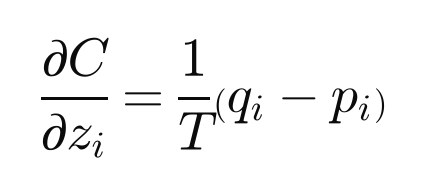
That is one factor of 1/T. On its own it does not make 1/T². The second 1/T comes from the fact that (qi − pi) itself shrinks as T grows.
5-2. The high-temperature approximation
When T is large compared with the logits, we can use exp(x) ≈ 1 + x:
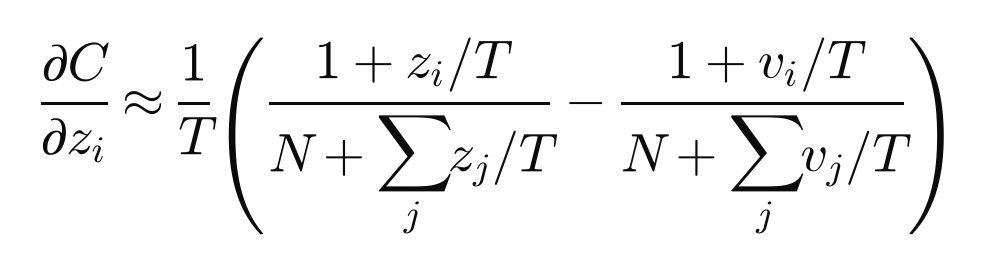
If the logits are zero-meaned for each example (∑zj = ∑vj = 0), the denominators become N and the expression simplifies:
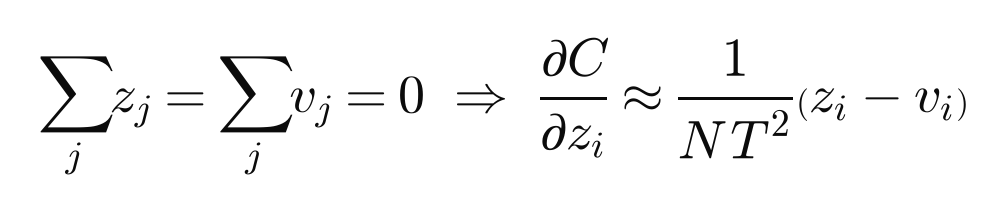
So the 1/T² comes from two places:
| Source | Size | Why |
|---|---|---|
| Chain rule | 1/T | The softmax input is z/T, not z |
| Probability gap (q − p) | ≈ (z − v)/(N·T) | As T grows, both distributions approach uniform, so their difference shrinks |
| Total | ≈ (z − v)/(N·T²) | The two effects multiply to 1/T² |
5-3. Checking with numbers
Using the teacher logits above and slightly different student logits, I computed the size (vector norm) of the gradient directly. For comparison, the hard-loss gradient (T = 1) in this example is about 0.0075.
| Temperature T | ‖∂Lsoft/∂z‖ | T² × ‖∂Lsoft/∂z‖ |
|---|---|---|
| 5 | 0.00595 | 0.149 |
| 10 | 0.00195 | 0.195 |
| 20 | 0.00054 | 0.216 |
| 50 | 0.00009 | 0.227 |
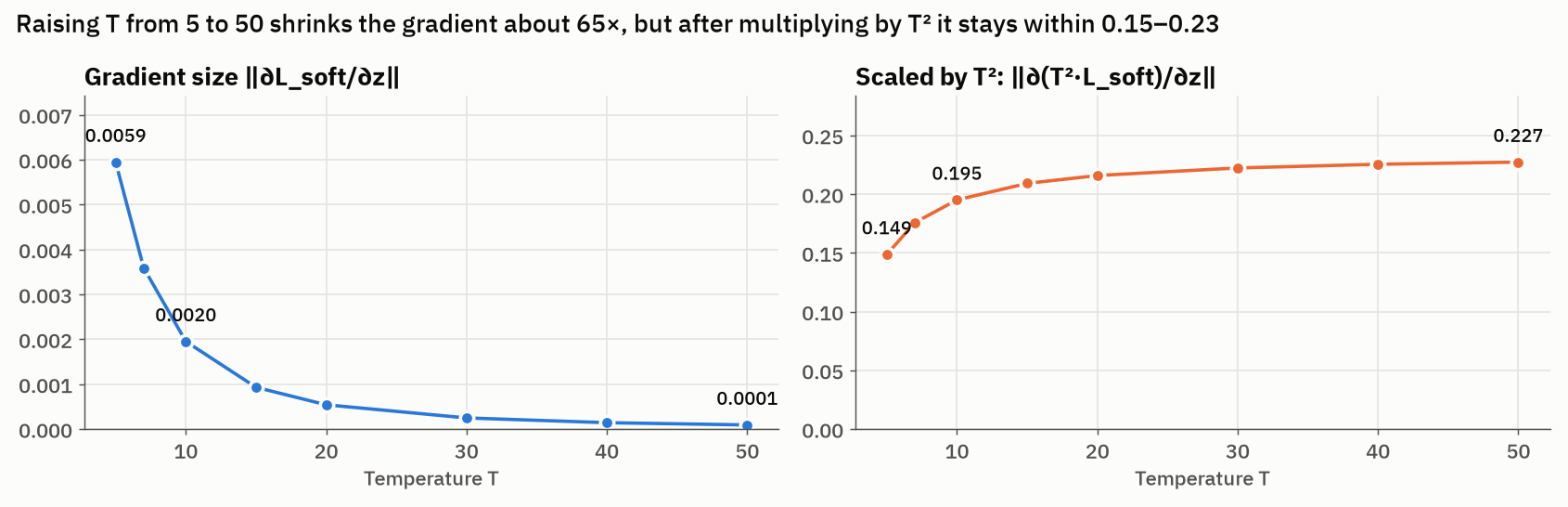
Raising T from 5 to 50 makes the gradient about 65× smaller. Without T², the soft loss would be drowned out by the hard loss as T grows and would barely contribute to training. With T², the values stay within 0.15–0.23, so changing T does not throw off the balance between the two losses. The larger T is, the more accurate the approximation, and the closer the value gets to constant.

💡 Why it matters in practice · In distillation you tune T and the weight α together. Without T², every change of T would force you to re-tune α. With T², you can change T in experiments and the relative contribution of the two losses stays roughly the same. It is less a mathematical necessity than an engineering correction that makes hyperparameter search easier.
6. Logit matching is a special case of distillation
Before distillation, Caruana and colleagues (Bucila et al. 2006, Ba & Caruana 2014) compressed large models into small ones by training the student to match the teacher's logits themselves, i.e., by minimizing (z − v)². Look again at the result of 5-2:
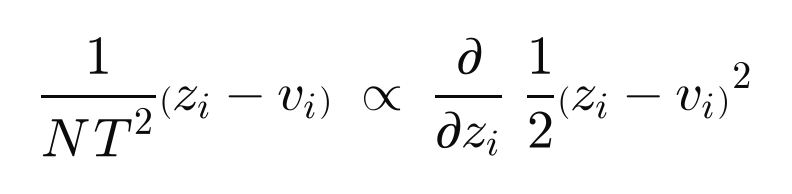
So when T is very large and the logits are zero-meaned, distillation is equivalent to logit matching. On this basis, the paper treats logit matching as a special case of distillation.
| Logit matching (Ba & Caruana) | Distillation (Hinton et al.) | |
|---|---|---|
| Target | The logits v themselves | Softmax probabilities at temperature T, p(T) |
| Loss | ½(z − v)² | Cross-entropy H(p(T), q(T)) |
| Relationship | Equivalent in the limit T → ∞ (with zero-mean logits) | |
| At intermediate T | Copies even very negative logits exactly | Pays less attention to very negative, noisy logits → can help when the student is small |
7. Implementing it in PyTorch
Here is the loss above, translated directly. KL divergence differs from cross-entropy only by the teacher's entropy, which is a constant, so the gradient for the student is the same.
import torch.nn.functional as F

def distillation_loss(student_logits, teacher_logits, labels, T=4.0, alpha=0.9):
    # 1) soft loss: both use the same temperature T
    soft_student = F.log_softmax(student_logits / T, dim=1)
    soft_teacher = F.softmax(teacher_logits / T, dim=1)
    soft_loss = F.kl_div(soft_student, soft_teacher, reduction="batchmean") * (T * T)  # T^2 correction

    # 2) hard loss: ordinary cross-entropy at T = 1
    hard_loss = F.cross_entropy(student_logits, labels)

    return alpha * soft_loss + (1 - alpha) * hard_loss
- The teacher is not trained, so compute its logits inside
torch.no_grad()or call.detach(). - Remove
* (T * T)and change T from 2 to 8: you will see the soft-loss value and its gradient drop sharply.
Summary
| Concept | In one line |
|---|---|
| Logit z | The raw output of the last linear layer, right before the softmax |
| Temperature T | Divide logits by T to soften the distribution. T > 1 only during training; inference uses T = 1 |
| Soft targets | The teacher's high-temperature softmax output; carries class similarity (dark knowledge) |
| Loss | α·T²·H(p(T), q(T)) + (1 − α)·H(y, q(1)) |
| Why T² | Gradient = 1/T from the chain rule × 1/T from the probability gap = 1/T². T² cancels it |
| Logit matching | A special case: equivalent to distillation as T → ∞ with zero-mean logits |
Reference · G. Hinton, O. Vinyals, J. Dean, "Distilling the Knowledge in a Neural Network", NIPS 2014 Deep Learning Workshop (arXiv:1503.02531). The numbers in the tables and charts were computed directly from the example logits assumed in this post.


Comments